|
|
  Our 1990 Merlot had gotten a lot of attention which was very good for our self esteem. As
we said, our 1990 Merlot received a Gold Medal at the Los Angeles
Country
Fair, a long story in and of itself. We had sent in the wine. When you
enter a competition you send it in with a check and an entry blank (you
don't go and present it to anybody). There are 100's of wineries,
1000's
of wines, panels of judges (5 or so per panel), and tasting and
spitting
for The judge (who hated California Merlots -- which was why he was on the panel -- thought that perhaps we were cheating! (Pouring Petrus into a bottle and sending it down to the competition.) So the judge actually came up here to the winery, wanting to buy 5 cases. We were limiting it to 1 case per person, so he said he would show up with 4 people and his sister with checks in hand. After buying the wine he wanted us to open a random bottle. Finally he was convinced. (And he told us we had "just missed" getting the "Best of Fair.") Pretty good introduction to the exciting world of wine competitions. People started finding us and it was kind of fun. We didn't enter a competition again until 1993 when we entered the 1992 Merlot in the San Francisco International Wine Competition. We won a Gold Medal there! We figured maybe that was why we were getting so many phone calls. And we figured this is nice, send the wine, get a Gold Medal. That
year we entered the San Diego National Wine Competition (which is very
stingy with its medals) and we got another Gold! We were starting to
catch
the attention of distributors Now Carol's brother, who lived in Pennsylvania and spent all of his vacation time in Atlanta wanted the wine so we found a distributor to represent us in Georgia. We began to ship to Washington State (which is where Carol is from). Tom Stockley of the Seattle Times gave us a really nice review. By 1993 we were producing 1500 cases (altogether) of Merlot, Cabernet, Sangiovese, Zinfandel and Chardonnay (simply because we don't have employees and our volunteers wanted a white; this really isn't Chardonnay country so we have about 3/4 acre planted in a shady area). Paso Robles began its own annual Wine Festival in 1982. (Since we wanted Paso Robles to do well, we always helped wineries set up in the City Park, starting at 6 a.m. We understood that the success of Paso Robles vineyards was tied to their wineries.) By the mid-90's Paso Robles was becoming more noticed. More wineries were opening and the area was gaining more respect overall. About
that time the Federal Government added a new wrinkle to the production
of wine. They eliminated the ability to expense the cost of production
prior to sale. What this meant We make it from the heart, not the pocketbook. After a decade of pouring wines out of the winery itself (among the cold and drafty barrels, as quaint as that might be) Gino decided we needed more room for barrels and Carol said "in that case I want a bigger area for the tasting room." Thus our first expansion. A tasting room (all of another 14 feet) was added onto the front of the winery. Some years later, now, we're talking to architects about more space. Some day that day will also come. Speaking of the addition, we asked the dry wall installer to put it up with a flat finish. He wanted to put a texture on it since otherwise every single imperfection and nail would show. But we wanted a mural. He acquiesced to the little old lady (Carol) wanting things done her own way. The
mural was taken from photos of the brothers' grandfathers' fathers'
fathers'
(ancestral) home in Italy: Stella San Martin with images of four
generations
of Peratas from the eldest The winery is always evolving. When we could afford a car or bottling line, we opted for the latter. That
short walk to work in the morning from the house to the winery or into
the vineyard evokes the same feeling, we think, our father, and
forefather's
must have had when they made their wine in Italy even as Carol and
Gino's
middle daughter plans on a life of oenology.
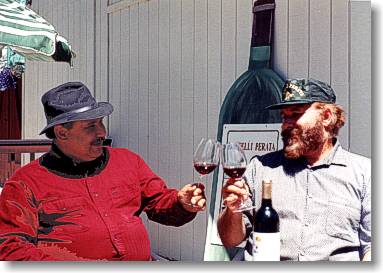
Fratelli Perata wines are treated like children when they are young, allowed to mature to become robust big wines, full of life. We think they always have something to say.
|
|
|
 two
days. When they finally poured our wine, number 78, the
response
was: "Did they slip us a Petrus to see if our palates are fatigued or
what?!"
two
days. When they finally poured our wine, number 78, the
response
was: "Did they slip us a Petrus to see if our palates are fatigued or
what?!"
 who
wanted the wine, but we had to tell most of them "no," since we sold it
all out of the tasting room and didn't even have enough for us to
drink.
We were producing about 300 cases of Merlot at that time, and perhaps
1200
cases altogether.
who
wanted the wine, but we had to tell most of them "no," since we sold it
all out of the tasting room and didn't even have enough for us to
drink.
We were producing about 300 cases of Merlot at that time, and perhaps
1200
cases altogether.
 was
that most wineries started to produce lighter style wines with more
stainless
steel and less oak since they could be sold young. We were still making
wines meant to be aged and the customers were nice enough to buy them
well
before they were meant to be drunk. Contrary to good financial
practices
we continue to make the wines in a big style: complex and not to be
drunk
for at least 3 to 5 years. (Zinfandel being the only exception as we
like
Zins which are fruity in their youth), Even more contrary to sound
finances,
we allow them to both barrel and bottle age at our winery. Hence
we were and still are selling a number of old wines. Our current
releases
are always older vintages than industry norm. For example, in 2002 we
are
selling several 1997 vintage
was
that most wineries started to produce lighter style wines with more
stainless
steel and less oak since they could be sold young. We were still making
wines meant to be aged and the customers were nice enough to buy them
well
before they were meant to be drunk. Contrary to good financial
practices
we continue to make the wines in a big style: complex and not to be
drunk
for at least 3 to 5 years. (Zinfandel being the only exception as we
like
Zins which are fruity in their youth), Even more contrary to sound
finances,
we allow them to both barrel and bottle age at our winery. Hence
we were and still are selling a number of old wines. Our current
releases
are always older vintages than industry norm. For example, in 2002 we
are
selling several 1997 vintage 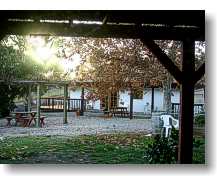 wines
as our current releases while most other wineries are selling their
2000
vintage wines.
wines
as our current releases while most other wineries are selling their
2000
vintage wines.
 Giuseppe
Antonio Perata to the youngest daughter, Joanne (Joseph Anthony, get
it?).
Giuseppe
Antonio Perata to the youngest daughter, Joanne (Joseph Anthony, get
it?).